Building Trust With New Website Visitors: A Practical Guide for Foreign Founders
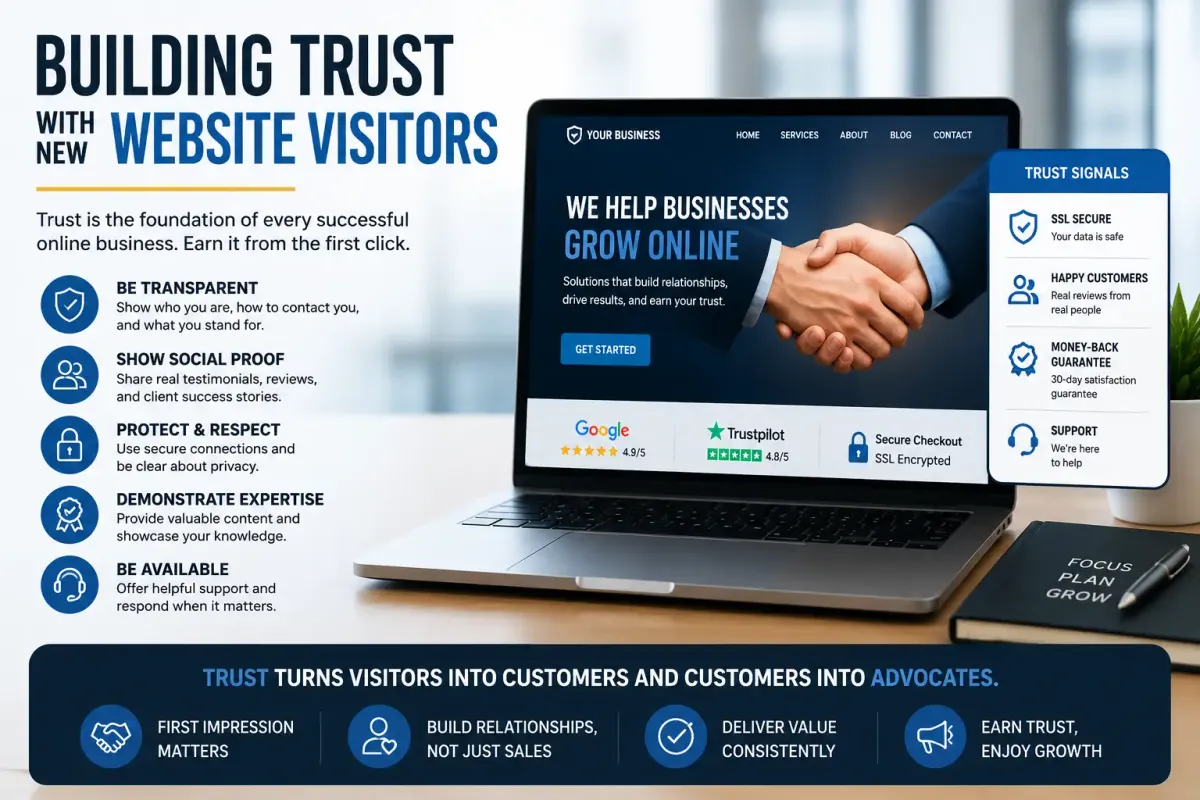
Trust is the currency of online business.
You can have the best product, the most competitive pricing, and a beautifully designed website, but if visitors don't trust you, they won't buy from you. They won't subscribe to your newsletter, schedule a call, download your lead magnet, or enter their credit card information.
For foreign founders operating businesses in the United States, building trust can be even more challenging. Many customers are unfamiliar with your brand, may not recognize your company name, and often have concerns about legitimacy, support quality, privacy, and payment security.
The reality is simple: visitors make trust decisions within seconds.
When someone lands on your website, they immediately ask themselves several questions:
- Is this company legitimate?
- Can I trust them with my money?
- Will they deliver what they promise?
- What happens if something goes wrong?
- Are there real people behind this business?
The answers to these questions determine whether a visitor becomes a customer or leaves forever.
In this guide, we'll explore practical strategies that foreign founders, online business owners, and digital nomads can use to establish credibility and build trust from the first visit.
Why Trust Matters More Than Ever
Online consumers have become increasingly cautious.
Every day, people encounter phishing scams, fake stores, misleading advertisements, AI-generated content, and questionable business practices. As a result, trust has become one of the most important conversion factors on any website.
Research consistently shows that visitors decide whether they trust a website within moments of arrival. Poor design, missing information, or unclear messaging can immediately raise red flags.
For businesses operating remotely or internationally, the challenge becomes even greater. Customers may wonder:
- Where is this company located?
- Is customer support available?
- Are they familiar with U.S. business standards?
- Will I be able to get help if needed?
The good news is that trust can be intentionally designed into your website experience.
Make Your Value Proposition Immediately Clear
Visitors should understand what you do within five seconds.
One of the biggest mistakes entrepreneurs make is assuming visitors already understand their business.
Instead of using clever slogans or vague marketing language, clearly communicate:
- What you offer
- Who it's for
- What problem it solves
- Why it matters
For example:
Weak headline:
"Reimagining Digital Excellence"
Strong headline:
"Helping U.S. Businesses Automate Customer Support With AI-Powered Chat Solutions"
Clarity creates confidence.
When visitors understand your offer immediately, they are more likely to continue exploring your website.
Display Real Contact Information
Nothing damages trust faster than a website that appears anonymous.
Even if you're a digital nomad traveling between countries, your website should provide legitimate ways for customers to contact you.
Include:
- Business email address
- Contact form
- Customer support information
- Business registration details when appropriate
- Social media profiles
- Physical mailing address or registered business address
For foreign founders serving U.S. customers, having a U.S. business entity or mailing address can significantly improve credibility.
Visitors want reassurance that a real business exists behind the website.
Create an Authentic About Page
The About page is often one of the most visited pages on a website.
Yet many business owners treat it as an afterthought.
People buy from people. They want to know who they're dealing with.
Your About page should include:
- Founder story
- Company mission
- Professional background
- Team members
- Company values
- Why the business exists
If you're a foreign founder, don't hide your background.
Instead, use it as a strength.
Explain your journey, expertise, and unique perspective. Authentic stories often build stronger emotional connections than generic corporate messaging.
Include professional photos whenever possible. Real faces increase trust dramatically compared to stock photography.
Use Professional Website Design
Visitors often judge business credibility based on design quality.
An outdated website can create the impression that your company is unprofessional, regardless of how good your products or services are.
Focus on:
- Clean layouts
- Mobile responsiveness
- Fast loading speeds
- Consistent branding
- Easy navigation
- Readable typography
Professional design communicates stability and attention to detail.
You don't need an expensive custom website. A well-designed template and strong branding can be more than enough.
Showcase Customer Testimonials
Social proof is one of the most powerful trust-building tools available.
When visitors see others benefiting from your products or services, uncertainty decreases.
Effective testimonials include:
- Customer name
- Company name
- Photo when possible
- Specific results achieved
- Detailed feedback
Avoid generic testimonials such as:
"Great service!"
Instead, focus on outcome-based testimonials:
"The team helped us increase qualified leads by 42% within three months."
Specificity increases credibility.
Highlight Client Logos and Partnerships
Recognition builds trust.
If you've worked with known companies, organizations, or brands, showcase their logos on your website.
Even smaller partnerships can provide credibility signals.
Create sections such as:
- Trusted By
- Featured Clients
- Partner Organizations
- Media Mentions
Visitors naturally transfer trust from recognizable brands to your business.
Publish Helpful Content Consistently
Content marketing is trust marketing.
When you consistently publish useful articles, guides, videos, and resources, visitors begin viewing your business as an authority.
Educational content demonstrates expertise before asking for a sale.
Examples include:
- Industry guides
- Tutorials
- Case studies
- Research reports
- FAQ articles
- Video demonstrations
For foreign founders, content is especially valuable because it allows you to showcase expertise without requiring prior brand recognition.
Knowledge creates authority.
Authority creates trust.
Trust creates sales.
Add Security and Privacy Signals
Visitors want assurance that their personal information is safe.
Trust signals include:
- SSL certificates
- Secure checkout badges
- Privacy policy
- Terms of service
- GDPR compliance information
- Payment processor logos
If you're collecting customer data, clearly explain:
- What information you collect
- Why you collect it
- How it's protected
- How users can control their data
Transparency reduces uncertainty.
Use Case Studies Instead of Claims
Anyone can make promises.
Few businesses can prove results.
Case studies allow you to demonstrate real-world success.
A strong case study typically includes:
- Customer challenge
- Solution provided
- Implementation process
- Measurable outcomes
- Client feedback
For example:
Instead of saying:
"We help businesses grow."
Show:
"How We Increased Monthly Revenue by 35% for an E-Commerce Brand."
Evidence is more persuasive than marketing language.
Make Pricing Transparent
Hidden pricing creates suspicion.
Whenever possible, clearly communicate:
- Product pricing
- Service packages
- Subscription costs
- Additional fees
- Refund policies
Even if you offer custom pricing, provide guidance.
Examples include:
- Starting at $500/month
- Most clients invest between $2,000 and $5,000
- Request a custom quote
Transparency demonstrates confidence and professionalism.
Provide Strong Customer Support
Support availability significantly impacts trust.
Visitors want to know help is available when needed.
Consider offering:
- Live chat
- Email support
- Knowledge base
- FAQ section
- Video tutorials
- Appointment scheduling
Fast response times build confidence before and after the sale.
Even automated support systems can reassure visitors when implemented correctly.
Demonstrate Industry Expertise
Authority helps visitors overcome skepticism.
Ways to demonstrate expertise include:
- Certifications
- Professional credentials
- Speaking engagements
- Published articles
- Industry awards
- Podcast appearances
For foreign founders entering the U.S. market, demonstrating expertise is often more important than demonstrating size.
Customers care less about where you're located and more about whether you can solve their problem.
Use Real Images Whenever Possible
Stock photos can make websites feel generic and impersonal.
Whenever possible, use:
- Team photos
- Workspace images
- Event photos
- Product photos
- Behind-the-scenes content
Authentic visuals help visitors connect with your business.
Real people create real trust.
Maintain Consistent Branding
Consistency signals professionalism.
Your website, emails, social media profiles, and marketing materials should all present a unified brand identity.
Consistency includes:
- Logo usage
- Color palette
- Tone of voice
- Messaging
- Visual style
Inconsistent branding can make businesses appear unreliable or temporary.
Strong brands feel stable.
Stable businesses earn trust.
Reduce Risk With Guarantees
Many visitors hesitate because they fear making a bad decision.
Risk-reversal strategies can help.
Examples include:
- Money-back guarantees
- Free trials
- Satisfaction guarantees
- No-contract options
- Flexible cancellation policies
When customers feel protected, they are more likely to move forward.
A guarantee demonstrates confidence in your product or service.
Collect and Display Reviews
Online reviews play a major role in purchase decisions.
Encourage customers to leave reviews on platforms such as:
- Trustpilot
- G2
- Capterra
- Product Hunt
- Industry-specific directories
Display review scores and ratings prominently on your website.
Independent reviews often carry more weight than testimonials because visitors perceive them as less controlled.
Build Trust Through Consistency Over Time
Trust is rarely built through a single website element.
Instead, trust emerges through dozens of small signals working together.
Visitors notice:
- Consistent messaging
- Regular content updates
- Active social media profiles
- Positive customer experiences
- Transparent communication
- Reliable support
Every interaction either strengthens or weakens trust.
The goal is to create a website experience where visitors feel increasingly confident as they learn more about your business.
Final Thoughts
Building trust with new website visitors is not about flashy design or clever marketing tricks.
It's about reducing uncertainty.
Foreign founders, online business owners, and digital nomads often face an additional challenge because customers may not already know their brand. However, trust can be earned through transparency, expertise, professionalism, and social proof.
The most successful online businesses intentionally design trust into every stage of the customer journey.
They clearly communicate what they do.
They demonstrate expertise.
They showcase real customer results.
They make it easy to contact them.
They provide transparency around pricing, security, and support.
Most importantly, they consistently deliver on their promises.
When visitors trust your business, conversions increase, customer relationships strengthen, and long-term growth becomes significantly easier to achieve.
Trust isn't simply a marketing asset.
It's the foundation of every successful online business.
Disclaimer: This article is provided for informational and educational purposes only. It does not constitute legal, accounting, or professional tax advice. Tax situations vary, and you should consult a qualified tax professional regarding your specific circumstances. For your safety, do not share sensitive personal information such as Social Security Numbers, tax ID numbers, or specific financial figures in any online conversation.