Tax Year vs Filing Year: What's the Difference?
Why the IRS uses two different "years" — and how mixing them up causes missed deadlines.
If you've read anything about US taxes for your LLC, you'll have seen both terms thrown around: the tax year and the filing year. They're not the same thing, and confusing them is one of the most common reasons UK founders file late — or file the wrong thing entirely. Here's the difference, in plain English.
The two definitions
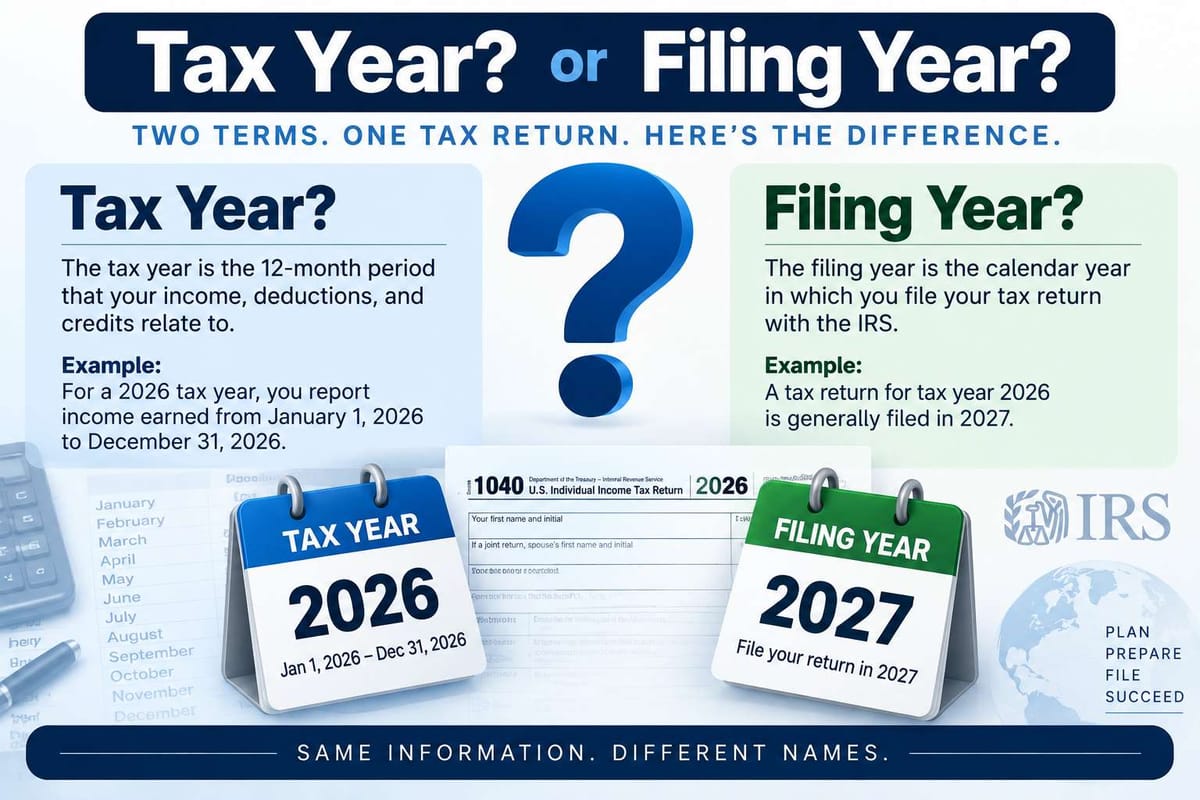
Your tax year is the period in which the income was earned. For almost everyone, it's the calendar year: 1 January to 31 December. Your 2026 tax year covers everything your LLC earned between 1 January 2026 and 31 December 2026.
Your filing year is the year in which you actually file the paperwork. Returns for the 2026 tax year are prepared, submitted and processed in 2027 — so that's your 2027 filing year. In short: the tax year is what you're reporting on; the filing year is when you report it.
Example 1 — Single-member LLC, calendar year
You run a Delaware SMLLC from London with related-party transactions in 2026. That activity belongs to your 2026 tax year. The Form 5472 and pro forma 1120 reporting it are due 15 April 2027 — squarely in your 2027 filing year. If you file Form 7004 for an extension by that April date, the paperwork moves to 15 October 2027 — still the same filing year, still reporting the same tax year.
Example 2 — Partnership
You own a US partnership with a US co-founder. The partnership's 2026 tax year closes on 31 December 2026, but Form 1065 (with Schedules K-1, K-2 and K-3) is due 15 March 2027 — before personal returns, so partners have their K-1s in time. Extension available to 15 September 2027. Notice the pattern: tax year 2026, filing year 2027.
Why the gap exists
US returns are due roughly 3.5 months after the tax year ends to give you time to gather books, statements and contractor records. Deadlines within the filing year then cascade: W-2s and 1099s due 31 January, partnership returns 15 March, LLC information returns and personal returns 15 April, payroll Form 941s quarterly throughout. Each of those dates sits in the filing year but reports all or part of the tax year.
Where it trips people up
- "My 2027 return." There's no such thing. In 2027 you file for tax year 2026. Saying "2027 return" invites the wrong forms and wrong dates.
- Deadlines that cross the boundary. Form 941 for Q4 2026 is due 1 February 2027 — a tax-year-2026 obligation landing in the filing year. Diarise it before you switch mental gears.
- Fiscal-year companies. If your LLC elects a non-calendar tax year (say, ending 30 June), every deadline shifts: your return is generally due the 15th day of the third month after year-end — 15 September for a 30 June close. The tax-year/filing-year logic is identical; only the dates move.
- Forms with no tax year at all. Form SS-4 (your EIN application) and Form W-8BEN aren't annual filings — they're one-off or event-driven, so neither year label applies.
The one-line rule: the tax year is the year the money moved; the filing year is the year you tell the IRS about it. Almost everything you'll file in 2027 reports your 2026 tax year.
Get this distinction right and the rest of the US filing calendar falls into place — every deadline in your diary simply becomes "filing-year date for tax-year activity." Get it wrong, and you risk filing a year early, a year late, or not at all, with penalties that don't care which year you meant.
Disclaimer: This article is provided for informational and educational purposes only. It does not constitute legal, accounting, or professional tax advice. Tax situations vary, and you should consult a qualified tax professional regarding your specific circumstances. For your safety, do not share sensitive personal information such as Social Security Numbers, tax ID numbers, or specific financial figures in any online conversation.